
You are using an out of date browser. It may not display this or other websites correctly.
You should upgrade or use an alternative browser.
You should upgrade or use an alternative browser.
Rate (Out of 10) and/or Review the Last Anime You Watched~
- Thread starter Aion (Retired)
- Start date
Dai
Combat Butler
Chainsaw Man: Reze Arc
This movie confused me. Not with its story, which is pretty simple. Not with its imagery, since anyone who has been watching anime for a while probably won't blink at the sight of a guy made of chainsaws riding a shark. No, what confused me is the level of care and artistry that has been lavished upon what feels like a fairly typical battle anime plotline merged with the excesses of a blood-and-boobs exploitation OVA from the 90s. Rather like the first season of One Punch Man, I was left wondering, "Why was this the story that made these animators bring their A-game?"
To be fair, there's nothing wrong with what's here. The first 40 minutes offer a solid build-up and look like they could present an interesting new angle for the series. I'm not sure the eventual twist can even be called that though, since it's so heavily telegraphed that you would need to have your eyes closed not to see it coming. What follows the twist is almost an hour of some the best animated action scenes I've ever seen. They're so impressive, in fact, that they almost distract from the fact that there is almost zero real plot going on behind them. The narrative arc of that hour of action is just that the villain wants to kill the protagonist for some reason that's never explained. Presumably this will be explained in a later arc (or maybe it was explained in season 1 and I forgot?), but within the confines of this movie specifically the stakes end up feeling like little more than a monster-of-the-week fight. Now, this is a shonen battle anime, so I shouldn't be too harsh on its emphasis on anime battling, but the production team raises the critical bar for themselves by trying to pass the movie off as something more prestige. There's some pathos in the denouement that elevates it, but not to the level that the lavish direction and Kensuke Ushio's patented sad piano are aiming for.
So what we're left with is a 6/10 story that's enhanced by 9/10 direction and music, and 10/10 animation. For me, it ends up at a 7/10.
This movie confused me. Not with its story, which is pretty simple. Not with its imagery, since anyone who has been watching anime for a while probably won't blink at the sight of a guy made of chainsaws riding a shark. No, what confused me is the level of care and artistry that has been lavished upon what feels like a fairly typical battle anime plotline merged with the excesses of a blood-and-boobs exploitation OVA from the 90s. Rather like the first season of One Punch Man, I was left wondering, "Why was this the story that made these animators bring their A-game?"
To be fair, there's nothing wrong with what's here. The first 40 minutes offer a solid build-up and look like they could present an interesting new angle for the series. I'm not sure the eventual twist can even be called that though, since it's so heavily telegraphed that you would need to have your eyes closed not to see it coming. What follows the twist is almost an hour of some the best animated action scenes I've ever seen. They're so impressive, in fact, that they almost distract from the fact that there is almost zero real plot going on behind them. The narrative arc of that hour of action is just that the villain wants to kill the protagonist for some reason that's never explained. Presumably this will be explained in a later arc (or maybe it was explained in season 1 and I forgot?), but within the confines of this movie specifically the stakes end up feeling like little more than a monster-of-the-week fight. Now, this is a shonen battle anime, so I shouldn't be too harsh on its emphasis on anime battling, but the production team raises the critical bar for themselves by trying to pass the movie off as something more prestige. There's some pathos in the denouement that elevates it, but not to the level that the lavish direction and Kensuke Ushio's patented sad piano are aiming for.
So what we're left with is a 6/10 story that's enhanced by 9/10 direction and music, and 10/10 animation. For me, it ends up at a 7/10.

Aion (Retired)
Chuunibyou
Chainsaw Man: Reze Arc
This movie confused me. "Why was this the story that made these animators bring their A-game?"
Disclaimer: I ain't seen the movie (yet), despite my namesake Dan having posted a review on the other page. Do have some insight via the manga, though.
Volume 6, which the film adapts, was probably the best single volume in the entire series. And whilst it was bombastic enough for the big screen, with shark riding and general bomb chaos, with an emotive

 end twist, I can't imagine beyond the audiovisual spectacle it'd be ideal stretched into a movie given the aforementioned telegraphing and general 1vol>movie pacing differences. Likely better as a fast/intense page flicker than flick. But too short be a TV arc, hence this situation.
The series goes utterly batshit, starting the next arc but more so after
 . Less interested in telling a story than insanity where characters are killed off willy-nilly, and the good parts like Power's driving skills are more isolated. Much of the remainder is like v6, but amped up to 1000%. After v9, it jumps the shark rather than continuing to ride it. So in that sense, giving one of the best remaining more... coherent bits the highest quality makes sense. If not to you as the viewer, to meeeee as a manga reader that dropped the series after v11.
Last edited:

Aion (Retired)
Chuunibyou
Chainsaw Man – Reze: 8/10
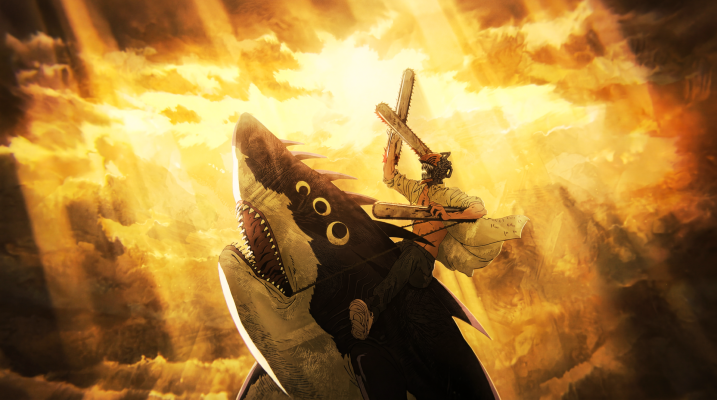
Jump-riding the shark and not (quite yet) falling off into the terribad anime abyss highlights Chainsaw Man's special brand of insanity... and how anime fans are indeed unblinking confronted with such absurdity~
That aside, finally got around to watching and, to my utter horror, discovered I was one-third incorrect in my earlier post: the film adapts half of v5 AND all of v6 into 90ish minutes. What this means is that name thief Dan being bored by the first half and Dai pondering why so much was lavished on a fight with a new 'monster-of-the-week' character in the other both have equal merit. DxD. The v5 setup was heavily extended, in some instances turning a few panels/pages into minutes. And the v6 fight was - 'bomb time' slow-mo & Superman smashing thru the actual Mappa building aside - as is on page; constantly leaving me pondering if fingers are being tossed like grenades (or if imitating FMA's Roy snapping his fingers), whilst explosions are used for propulsion through the firework-laden sky.
'Tis the fact the plot could be summarised in a half-arsed sentence that is the issue: Denji meets a new girl, they talk about mice and things get explosive (rather amusingly, only after Reze feels rejected for another girl, does she... react. Makima's timing is similarly... reactive.) In fairness though, story is rarely a consideration for this series: up to this movie-point, it is as an exasperated Denji comically details on top of a gaudy CG car (when the TV ED3 aka anthem of chainsaw plays): every girl he knows has just so happened to try to kill him. On the down-low, this is a series dedicated to Denji's woes with nutty women; an actiony Aku Hana, if you will. Crazy attracts crazier, clearly. A few Aki moments that hint at later happenings aside, it was a self-contained romp.
Usually, dragging out half a volume until action would be dreadfully dull. The tingymajig is, Chainsaw Man's author does not let scenes breathe. He is chaos incarnate, and his idea of a love story is a psychotic one, ran along a chainsaw's edge, with no time to process as tongues are bitten off and bombs genocide the Japanese populace. His helter skelter pacing left me only recalling v6, as that's where his work shined. The movie focuses on the other end of that stick by balancing the two uneven segments into half build-up, half pay-off. Most notably improved is the school segment--the pool scene in the manga being 3-4 pages, whilst in the anime Ushio's 'in the pool' track is over 4mins (plus a shorter 'in the sea' remix, later, when it comes full circle~). Through a combination of the inhibition free liberation added by the (oddly nippleless) visual flourishes and Ushio's sentimental piano keys enriching it, it becomes something more; perhaps Denji's one true moment of happiness.
Whilst typing Ushio, thus far his body of work broadly speaking consists of two types: atmospheric romantic ambience and... Devilman/Chainsaw (PS: Reze includes a remixed driving track / from Devilman). Here he frequently blends these two distinct styles into individual tracks via a sort of musical mix alchemy, such as the fireworks scene. The highlight however is immediately after the pool part, when a Se7en style serial killer (re)appears, complete with an appropriately unsettling tune befitting the mood 180. Even knowing Reze isn't quite as into Denji as she lays on (less in an ANIME way, more 'there's no way a woman would be this touchy, so fast, or find Denji THAT funny'), I found myself immersed. The colour changes (blue to red), lighting in the dark and tension all hit harder than b&w manga. It adds so much to the suspense, seeing and hearing her 'terror' as she runs to the roof, girlishly. But more interestingly, the anime not only extends this sequence with animation but intersperses what was originally an image of Denji fantasising about his 'harem' during this chase; totally oblivious. The 'two storms' track plays perfectly insync, nailing it. The... No Country For Old Men intro switcharoo was of course expected but, nonetheless, I could not help but be pulled in by the audiovisual splendor.
With regards to the film's presentation, I noted Other Dan was displeased with the art change from S1 to Reze. Naturally, I find myself agreeing with Dan, for it was one of my main reservations going in, too. Y'see, S1 slightly changed the manga's art style, which has what I can best describe as a cartoonish derp to it. The TV series had a polished, more cinematic look (ironically in contrast to the movie) and definitely looked better. But the difference didn't bother me as much as expected; partly because of my goldfish memory only registering anime music but also due to 'they just animated the manga' undersells the work done. Even small things like watching Makima walking away, with Denji briefly stun-locked after the trip to the movies is more evocative, now. And THAT rat-infested alleyway leading to the cafe at the start/end getting more than a few panels as Reze's route, charted from the phone booth to cafe in rich animated detail, adds a thematic weight linking the two events far more memorably than with a couple of throwaway panels. Plus, they didn't merely add animation: the from behind, gruesome bathroom introduction to Mr. Se7en differed from the manga, where it was side-on, and there was no victim.
My original score was in-line with Dai's triple grading. Whilst the last half mixed it up as best it could, with Aki's samurai cameo and surely the most self-aware moment ever shared between creator and viewer when Denji opts to ride a shark like a horse amidst a... typhoon, the longer an action sequence extends - no matter how well executed, or if sharks are rode - the less impact it holds. As a result, my favourite scenes were at the school long before, and the ending.
Having sat on it for as long as laziness to type allowed, the alleyway sequence swayed meee. A lot of the thanks go to the manga, as nothing was changed - including how little was said and how much was said by those few words ("I too prefer the country mouse"~) - but, as was the case with the film as a whole, the presentation/music elevated it. Seeing ****** appear like Eu Sunt Dracul, with many-a-rat, was impressive. But what moved meeee was one of the most beautiful pieces of music I've heard, with nods to the classics. It went through the three stages of anime grief: beginning hopeful, then ominous longer key strokes... before becoming almost peaceful.
TLTR: A rare anime +1 where it improved the manga (the first half), at the cost of slowing things down and perhaps making some parts, such as the cinema date, a touch too long in the tooth. Ushio's music added emotional gravitas to what could otherwise be described as shallow. And mirroring the path to the alleyway, connecting the start to end, is a wonderful addition. Overall, this film is something akin to if Shinkai were to try his hand at a doomed, psychotic romance (wish he would rather than milking Your Name forever more tbh...) between half man, half chainsaw Denji and his bombergirl waifu.
They do say there's a fine line between genius and stupidity, and Chainsaw Man's author certainly lives on that line. There will be emotional moments that hit home harder than one-shot Reze, and even crazier action, but this will remain the most consistent high point given it's a standalone movie with a clearly defined start, middle & end. The same cannot be said of the rest.
Frieren - Season 2: 7/10

Rarely does a series dance to two distinct, opposing beats; one of which I adore, the other... not so much.
There is the bittersweet regret that comes with living a near immortal life, as an autistic elf--one that managed to spend 10yrs saving the world alongside a hero that fell for her, all the while remaining none the wiser 'till he was near dead and - worse yet - bald. By traveling with her student Fern, both grow via almost slice of life, School Rumble-stylin' (minus the spazzy energy) half eps. Ignoring flashbacks that are on the nose in order to shove Frieren's original journey in alongside her new one, there is a restrained subtlety that limits inner thoughts to deadpan comedic skits.
...Then, there is the flashy shounen fanfare. 'Tis as if Howo the Wisewolf were to sully herself by giving running battle commentary, as a side gig to acquiring apples. Mercifully, Frieren has so much budget that the action is oft in fluid motion (ie mostly evading talk no justu)... whilst overlaid with intrusive thoughts. This noticeable downgrade in writing quality can be compartmentalised by those long since mind-broken by anime. And nothing up to yet - bar the accursed chunin exam redux arc - has been drawn out forever more. Yet.
Preamble aside, this brings me to S2 of Autistic Waifu Chronicles. Only 10 eps in contrast to S1's 28, with a focus on what I wanted to see: half ep traveling. The journey is very much more important than the destination, 'ere. That said, there were less memorable moments given S1 already covered most of Frieren's Himmel/corrupt priest flashbacks of note. And besides Stark & Fern continuing to edge ever closer via a rather charming date ep where Stark realised a bullet point guide is autopilot robotic, there wasn't anything on par with S1 with the main trio, either. A big loss from S1 is the priest character whose name eludes me, given Frieren is emotionally stunted and the other two are still young--his more mature mediator role was straight man comedy gold in S1. There were still nice moments, such as a trip to an onsen and 100yr dwarf bridge saga coming to a close. However, the plot needs to advance to unlock more meaningful character moments. Frieren did find Himmel's memoirs, and her unaware smile highlighted her growth, but that's all he/she wrote.
In truth, I came away a bit disappointed. The presentation whilst still mostly excellent didn't hit the consistent highs expected of 10 eps. Much of the budget, or at least sakuga/animation ooo went into ep8's shounen battle, where Stark channeled Wolverine to somehow not be killed in a 2v1 battle against a 4-armed/sword snake demon. Even the excellent music, despite a brand new OST, had 'Is this the Braveheart OST?' S1 familiarity; only the aforementioned snake demon and its stop-start flutey tunes standing out.Additionally, one half ep rather exposed the gulf in depth between the slice of life journeying and demon warzu aspects: apparently, there was some never before mentioned hero, stronger than even Himmel, that took on all seven sages of destruction + some also never before mentioned overseer solo; halting the demon advance in the process. That this lore was tossed in as it was - in the latest flashback cameo of Himmel - did little to sway my feelings that the medieval world and its history are not nearly as fleshed out as its cast. At times, it makes me think of 1D isekai's and their demon kings. 'Tis displeasing.
But I digress: apart from the brief return to shounen battle moed (Frieren casually stayed out of battle... which kindasorta kills any tension; at least regarding Fern), S2 was the non-spazzy autistic comfort food I crave. Well, besides the one gag where Frieren turned into a crybaby, disturbing me greatly. And like in S1, I very much enjoyed the action vs episodic monsters that neither talk nor evoke the need for inner obvious waffling to be swiftly dealt with. 'Tis pleasing.
I am a lil' worried going forward given next up is going to be an arc dealing with the strongest and/or goldest out of the 7 sages of destruction, in what looks like an Elden Ring area. Doubtless, the series' struggle to marry the idea of a 'journey beyond journey's end' with shounen demon showdowns to the death will continue, whilst Frieren remains able to casually one-hit laser any and every demon (very much like an Elden Ring mage summoned to help with bosses).
Despite the blend of impactful regret and more tedious (though brief) demon battling, I shall stick with it for the introspective characterisation that does not make me feel quite as old as to recall my misspent teenage Naru(tarded) days. At least Frieren goes feral when it comes to killing demons, as opposed to them becoming nakama. That's a +1.
Last edited:

Vashdaman
Cardcaptor
Riding Bean
Really enjoyed this action crime comedy which I gather is a pilot, sadly, for a show that never got made. It kind reminds a little of a slight version of something like Castle of Cagliostro. Just a fun joyous romp, with some really lovely animation (why doesn't modern animation look this good?), and some brilliant exuberant car chase scenes. The lead protagonist Bean Bandit is for some unexplained reason invincible and impervious to seemingly all forms of physical harm. Bullets bounce off of him like he's Superman. I don't know if there was ever any plan to explain these powers, but while it's unusual to see a protagonist so explicitly unkillable, it's sort of fun and it doesn't really impact tension much when the average action hero is essentially usually invincible anyway. But anyway, Riding Bean is wonderful fun, full of cool action and style and a great soundtrack too.
I know this ended up sort of becoming Gunsmith Cats, but it kind of surprised me looking at Wikipedia to find that the 3 episode OVA is all the Gunsmith Cats anime that was ever made. For some reason I was under the mistaken impression it rumbled on through into the noughties and received multiple different series. But I suppose not! It's such a well known title I always thought there was more, and it's a shame there isn't.
Really enjoyed this action crime comedy which I gather is a pilot, sadly, for a show that never got made. It kind reminds a little of a slight version of something like Castle of Cagliostro. Just a fun joyous romp, with some really lovely animation (why doesn't modern animation look this good?), and some brilliant exuberant car chase scenes. The lead protagonist Bean Bandit is for some unexplained reason invincible and impervious to seemingly all forms of physical harm. Bullets bounce off of him like he's Superman. I don't know if there was ever any plan to explain these powers, but while it's unusual to see a protagonist so explicitly unkillable, it's sort of fun and it doesn't really impact tension much when the average action hero is essentially usually invincible anyway. But anyway, Riding Bean is wonderful fun, full of cool action and style and a great soundtrack too.
I know this ended up sort of becoming Gunsmith Cats, but it kind of surprised me looking at Wikipedia to find that the 3 episode OVA is all the Gunsmith Cats anime that was ever made. For some reason I was under the mistaken impression it rumbled on through into the noughties and received multiple different series. But I suppose not! It's such a well known title I always thought there was more, and it's a shame there isn't.
Dai
Combat Butler
His leather jacket and headband are lined with Kevlar, but it's not mentioned in the anime. I only recall that from the liner notes included with the VHS release. Those notes don't explain how he can rip a car door off with his bare hands though...The lead protagonist Bean Bandit is for some unexplained reason invincible and impervious to seemingly all forms of physical harm. Bullets bounce off of him like he's Superman.
I presume that was rhetorical, but if not then the answer is the combination of the 80s bubble economy, OAV budgets, and animators who weren't yet burnt out from an industry that would demand an ever increasing amount of product to be churned out each year after the turn of the millennium.why doesn't modern animation look this good?
Vashdaman
Cardcaptor
I was going to reply with "but doesn't he get shot in the head?" But I googled it and discovered that Bean's headband is bulletproof too, which is pretty funny.
The animation question wasn't completely rhetorical. Although I knew that its budget definitely was a factor, as I'm watching Bubblegum Crisis at the moment, and despite it still looking great to me, it's obviously nowhere near as lavish as Riding Bean. I would think the other points you mention about animator burnout and workload churn are really key and important points too.
But I also wonder even with all those aforementioned factors in place, how much the actual physical materials involved in older animation contribute to the look. Like, presumably even high budget anime these days simply won't use cels and thus won't use real paint etc. I remember a while back looking at some Reddit thread and the OP poster was like "bring back cel anime!" but the consensus in the comments seemed to be, from what I can remember anyway, that there are no inherent qualities to cel based animation and that cels are completely redundant. Now, I know absolutely nothing about the science and the art of animation, but I really struggle to wrap my head around the idea that using an entirely different set of materials as the basis of an animation wouldn't impact the final result in any way. Surely there'll be more variation in the end product of cel animation, more richness you could even say? Often even when I encounter some slightly "shoddy" irregular bit of animation in older shows, like recently when I was watching GTO, it really makes it a richer visual experience for me. Now that I'm typing this it's occuring to me that there's probably some sort of cursed AI generated "cel animation filter" out there. But it still wouldn't be the same.
The animation question wasn't completely rhetorical. Although I knew that its budget definitely was a factor, as I'm watching Bubblegum Crisis at the moment, and despite it still looking great to me, it's obviously nowhere near as lavish as Riding Bean. I would think the other points you mention about animator burnout and workload churn are really key and important points too.
But I also wonder even with all those aforementioned factors in place, how much the actual physical materials involved in older animation contribute to the look. Like, presumably even high budget anime these days simply won't use cels and thus won't use real paint etc. I remember a while back looking at some Reddit thread and the OP poster was like "bring back cel anime!" but the consensus in the comments seemed to be, from what I can remember anyway, that there are no inherent qualities to cel based animation and that cels are completely redundant. Now, I know absolutely nothing about the science and the art of animation, but I really struggle to wrap my head around the idea that using an entirely different set of materials as the basis of an animation wouldn't impact the final result in any way. Surely there'll be more variation in the end product of cel animation, more richness you could even say? Often even when I encounter some slightly "shoddy" irregular bit of animation in older shows, like recently when I was watching GTO, it really makes it a richer visual experience for me. Now that I'm typing this it's occuring to me that there's probably some sort of cursed AI generated "cel animation filter" out there. But it still wouldn't be the same.
Aion (Retired)
Chuunibyou
Feeling lazy since nothing has triggered my semi-autistic tltr recently, soooo... here be my latest (failed) attempt at being concise. Ganbare, Aion~
Perhaps fittingly given its snowy Mother... "R/Loviet" setting, this proved to be the only of Takeshi Koike's four Lupin OVAs to leave me cold. Well, that is not entirely true, as I unsurprisingly found myself initially immersed by his tonally muted yet visually stylish approach. Which was further fueled by Bourne-esque car action and an Uncharted train set-piece, complete with some light boxing and train top / bridge jumping... only for it to then - perhaps also fittingly - completely derail in the last half.
The second half was rushed and, at times, utterly baffling. Half-arsed peace treaty / terrorism plot shenanigans, with Koike clearly struggling once his brand of to-the-point action coolness bashed head first into his Achilles' heel: nuanced complexity. Worse, there is no fun heist subplot to distract or intrigue 'ere, and not helping matters any is Zenigata coming across like a support character in his own OVA due to the titular Lupin duo having all the focus. Zeni was reduced to bizarrely spending the last half dragging himself around with a totally-non-fatal gut wound (conveniently ambling into the bunker of replacement-Putin, for a Lupin x Zeni x Lupin finale. Somehow.) Lupin's clone meanwhile remained a 1D cartoon that had his most interesting aspect turn out to be just... how, exactly, he disguised himself as a certain femme fatale. HOW!? I could more readily accept a genetic clone body double! The final showdown also proved anti-climatic, given Evil Lupin was a dumbarse and Zeni remained half-dead.
This is all such a pity when Zenigata is my favourite Lupin character. He was made endearing to me in a Lieutenant Yamamoto (/Tylor) despairing reaction sense. His character also channels Inspector Javert's (/Les Mis) obsession, turned comical via forever chasing/losing Lupin. Often paired with some surprisingly excellent introspective heart-to-heart moments in other Lupin works. In Koike's universe though, the comedy is drained of cartoony silliness in the pursuit of 'cool', so all you're left with is a man with a tunnel vision for justice soooo narrow that it lead Javert to his own bitterest of ends. It's all played too straight, simply put, with musings on justice an edgy teenager could readily share when interacting directly with Lupin.
'Tis the problem with Koike's approach: whilst Jigen/Goemon's OVAs gained my strong approval as standalone Kawajiri>Koike wild west/samurai duel legacy works, they were not 'good Lupin' entries. Although I am at a loss as to what actually is when you need combine a thief, gunslinger, samurai, cop and seductive woman into one cohesive narrative, inevitably resulting in a mess. Koike narrows the scope, whilst adding stylish 80/90s manly sex appeal... that, and Fujiko fully nude in a fish-tank; chased by a manbot and its drillcock (srsly: Jigen's OVA). And killing with 'love' in her OVA, for how else can a woman kill in a man's fantasy?...
At the very end, the whole cast converge to head towards a movie finale that connects all four spin-offs. The whole thing being essentially one big A-to-B airport means to an end, leaving everything of consequence to be resolved in Immortal Bloodline. That was the only goal... and we'd have likely been better off skipping from Fujiko's OVA to that point. Whilst Lupin's clone saw Mamo in a brief trippy sequence, there was assuredly little else worth seeing. But I guess if you're going to be a mediocre filler tangent, best to do it in style. Maybe.
Seven kids find themselves transported to a medieval castle and are greeted by a mischievous girl wearing a wolf mask. There they are given the task of finding a key, with the reward being that one person gets their wish granted. The problem with this setup is 40-minutes (out of 2hrs) and around 4-months pass with barely anything happening. The castle becomes a support group/hangout spot for troubled teens (some recluses, some going to 'alternate schools'), instead of the magical locale being explored (not helped by the bland CG bgs). Much of the fantasy is mere window dressing for interpersonal drama. Think Persona but only early social linking, at the dungeon instead of outside it, and you wouldn't be far off the mark. Only the introverted and socially anxious heroine shines, here. And this is likely why Colorful remains something of a buried treasure: the director goes at his own slow-burn pace, with little interest in hooking viewers.
Lonely does however come to life, after its mundane and surface level trauma beginnings: we get to see how the bullying the heroine endured affected her, including one deeply unsettling scene where her bullies show up at her house as she desperately tries to lock all the doors. The mystery of the castle and how all seven are connected is explored--both inside and outside the castle. And the trauma of another one of seven comes to the fore; pushing the film towards an emotionally moving finale that ties every character together.
Even so, ultimately the earlier pacing issues and a lack of time/effort put into explaining the supernatural setting (complete with a mythical
 ) left me disappointed. Instead of there being a price of admission for fantastical wish-granting, an attempt was made at papering over the many holes with lost sister sentiment. And that, along with the big twist of how the seven were connected being hidden behind no-one bringing their phone/trendy clothes etc hurt it for meeee. Plus, half of the kids barely had any development are are kind of just there for the end twist.
Still, it carried an emotional weight and had the sort of impactful resolution that few cartoons manage nowadays. Colorful is undoubtedly the better of the two yet this director is doomed to be in the 6-7+ range. His films structure often makes me ask 'Why is this an anime moviefilm?'... all the while leaving me wanting to watch more. As luck would have it, turns out own two more films had long since forgotten were directed by Hara: Birthday Wonderland and Coo. Thanks, Anime (un)Limited xmas sales. And farewell.
Lupin the IIIrd: Zenigata and the Two Lupins
5.5/10
5.5/10
Perhaps fittingly given its snowy Mother... "R/Loviet" setting, this proved to be the only of Takeshi Koike's four Lupin OVAs to leave me cold. Well, that is not entirely true, as I unsurprisingly found myself initially immersed by his tonally muted yet visually stylish approach. Which was further fueled by Bourne-esque car action and an Uncharted train set-piece, complete with some light boxing and train top / bridge jumping... only for it to then - perhaps also fittingly - completely derail in the last half.
The second half was rushed and, at times, utterly baffling. Half-arsed peace treaty / terrorism plot shenanigans, with Koike clearly struggling once his brand of to-the-point action coolness bashed head first into his Achilles' heel: nuanced complexity. Worse, there is no fun heist subplot to distract or intrigue 'ere, and not helping matters any is Zenigata coming across like a support character in his own OVA due to the titular Lupin duo having all the focus. Zeni was reduced to bizarrely spending the last half dragging himself around with a totally-non-fatal gut wound (conveniently ambling into the bunker of replacement-Putin, for a Lupin x Zeni x Lupin finale. Somehow.) Lupin's clone meanwhile remained a 1D cartoon that had his most interesting aspect turn out to be just... how, exactly, he disguised himself as a certain femme fatale. HOW!? I could more readily accept a genetic clone body double! The final showdown also proved anti-climatic, given Evil Lupin was a dumbarse and Zeni remained half-dead.
This is all such a pity when Zenigata is my favourite Lupin character. He was made endearing to me in a Lieutenant Yamamoto (/Tylor) despairing reaction sense. His character also channels Inspector Javert's (/Les Mis) obsession, turned comical via forever chasing/losing Lupin. Often paired with some surprisingly excellent introspective heart-to-heart moments in other Lupin works. In Koike's universe though, the comedy is drained of cartoony silliness in the pursuit of 'cool', so all you're left with is a man with a tunnel vision for justice soooo narrow that it lead Javert to his own bitterest of ends. It's all played too straight, simply put, with musings on justice an edgy teenager could readily share when interacting directly with Lupin.
'Tis the problem with Koike's approach: whilst Jigen/Goemon's OVAs gained my strong approval as standalone Kawajiri>Koike wild west/samurai duel legacy works, they were not 'good Lupin' entries. Although I am at a loss as to what actually is when you need combine a thief, gunslinger, samurai, cop and seductive woman into one cohesive narrative, inevitably resulting in a mess. Koike narrows the scope, whilst adding stylish 80/90s manly sex appeal... that, and Fujiko fully nude in a fish-tank; chased by a manbot and its drillcock (srsly: Jigen's OVA). And killing with 'love' in her OVA, for how else can a woman kill in a man's fantasy?...
At the very end, the whole cast converge to head towards a movie finale that connects all four spin-offs. The whole thing being essentially one big A-to-B airport means to an end, leaving everything of consequence to be resolved in Immortal Bloodline. That was the only goal... and we'd have likely been better off skipping from Fujiko's OVA to that point. Whilst Lupin's clone saw Mamo in a brief trippy sequence, there was assuredly little else worth seeing. But I guess if you're going to be a mediocre filler tangent, best to do it in style. Maybe.
Lonely Castle in the Mirror
6.5/10
Watched out of affection for director Keiichi Hara's other film, 'Colorful', which won a place in my otherwise monochrome heart. Much like Lonely (and so much so that he had reservations about adapting another, similar novel), Colorful explores the mental health struggles of junior high aged kids. Where as that begins more compellingly, with suicide and the chance to try again, Lonely instead has a far more roundabout approach; one that almost suggests a 'battle royale' game scenario is afoot. Alas, 'twas not to be, for that was never the intent. 6.5/10
Seven kids find themselves transported to a medieval castle and are greeted by a mischievous girl wearing a wolf mask. There they are given the task of finding a key, with the reward being that one person gets their wish granted. The problem with this setup is 40-minutes (out of 2hrs) and around 4-months pass with barely anything happening. The castle becomes a support group/hangout spot for troubled teens (some recluses, some going to 'alternate schools'), instead of the magical locale being explored (not helped by the bland CG bgs). Much of the fantasy is mere window dressing for interpersonal drama. Think Persona but only early social linking, at the dungeon instead of outside it, and you wouldn't be far off the mark. Only the introverted and socially anxious heroine shines, here. And this is likely why Colorful remains something of a buried treasure: the director goes at his own slow-burn pace, with little interest in hooking viewers.
Lonely does however come to life, after its mundane and surface level trauma beginnings: we get to see how the bullying the heroine endured affected her, including one deeply unsettling scene where her bullies show up at her house as she desperately tries to lock all the doors. The mystery of the castle and how all seven are connected is explored--both inside and outside the castle. And the trauma of another one of seven comes to the fore; pushing the film towards an emotionally moving finale that ties every character together.
Even so, ultimately the earlier pacing issues and a lack of time/effort put into explaining the supernatural setting (complete with a mythical
) left me disappointed. Instead of there being a price of admission for fantastical wish-granting, an attempt was made at papering over the many holes with lost sister sentiment. And that, along with the big twist of how the seven were connected being hidden behind no-one bringing their phone/trendy clothes etc hurt it for meeee. Plus, half of the kids barely had any development are are kind of just there for the end twist.Still, it carried an emotional weight and had the sort of impactful resolution that few cartoons manage nowadays. Colorful is undoubtedly the better of the two yet this director is doomed to be in the 6-7+ range. His films structure often makes me ask 'Why is this an anime moviefilm?'... all the while leaving me wanting to watch more. As luck would have it, turns out own two more films had long since forgotten were directed by Hara: Birthday Wonderland and Coo. Thanks, Anime (un)Limited xmas sales. And farewell.
Hmm, I see your aversion to numbers remains intact, Vash. I shalt break you. Eventually. Then, Aiondamann will be my new username, for there can only be one, much like in the case of 'Dan'~
Anime was once art. Every background etched with hand-drawn wear & tear, colours hand-painted vs accursed digi-paint. The whole image blended seamlessly, with nary a bland CG wall/house in sight. And talented people revolutionising the industry; creating as fans, for fans. Now, it's merely a product, often made as cheaply as possible, without soul or passion bar some (mostly) shounen exceptions. Just look at Disney: from magical 2D creativity, to all CG soulless, around roughly same time period. Once the 2000s began and the digital switchover became the norm, with even Madhouse falling and Ghibli trailing off, it was the end. But before that, with AIC etc and the OVA boom ending, the rot began. Not even Trigun could not save it.
Every medium has a golden age. Be it JRPGs with the PS1, Korean cinema in the mid 2000s: a time when talent is not yet burned out, and what's new is not yet ground into dust via capitalism and time/cost.
That aside: your mention of Riding Bean had me remember I happen to have its BD inside my Gunsmith OVA case, thanks to my friend getting revenge for the discs I sent him. Tried it again dubbed, giving up halfway. A long time ago, half-asleep, I - unwisely as turned out - opted to try its (shoddy iirc) DVD. Going dubbed, in the hope of staying awake. That was a grave error: the dub is comically stilted and amateur, to the point was genuinely unable to follow the what/why besides a guy eating nuts and his car's wheels going... sideways. A highlight was when the scene switched to some older fella tied to a chair, with his female captor overly eager/excited to help him urinate via a handheld urinal (cue his eyebrow raise reaction -> no, thank you!). Then, the girl's femdom gf came in, slapping her around (which the girl liked). But the true highlight - which I'm not sure if I imagined, delirious - was the lead kicking a door down/couch over, followed by saying "I'm Bean, bitch!" in a monotone voice. Or something to that effect. That made me decide to 1/10, just for the experience/Mr. Bean image projected into my head. True story.
I recommend watching 'Drive', instead. It occurred to me whilst watching that it is the anime equivalent to... this. Just not terribly dubbed and without horizontal sidewheeling. The scene early on where Mr. Bean Bandit helped some criminals in masks escape reminded me of it. Drive has a song featuring 'a real human bean' lyrics, even! Ryan Gosling pretending to have Asperger's whilst being the most idealised example of a Clint Eastwood man of few words is also preferable to a... bean bandit. And Ryan Gosling in every other role where he actually speaks.
Anime was once art. Every background etched with hand-drawn wear & tear, colours hand-painted vs accursed digi-paint. The whole image blended seamlessly, with nary a bland CG wall/house in sight. And talented people revolutionising the industry; creating as fans, for fans. Now, it's merely a product, often made as cheaply as possible, without soul or passion bar some (mostly) shounen exceptions. Just look at Disney: from magical 2D creativity, to all CG soulless, around roughly same time period. Once the 2000s began and the digital switchover became the norm, with even Madhouse falling and Ghibli trailing off, it was the end. But before that, with AIC etc and the OVA boom ending, the rot began. Not even Trigun could not save it.
Every medium has a golden age. Be it JRPGs with the PS1, Korean cinema in the mid 2000s: a time when talent is not yet burned out, and what's new is not yet ground into dust via capitalism and time/cost.
That aside: your mention of Riding Bean had me remember I happen to have its BD inside my Gunsmith OVA case, thanks to my friend getting revenge for the discs I sent him. Tried it again dubbed, giving up halfway. A long time ago, half-asleep, I - unwisely as turned out - opted to try its (shoddy iirc) DVD. Going dubbed, in the hope of staying awake. That was a grave error: the dub is comically stilted and amateur, to the point was genuinely unable to follow the what/why besides a guy eating nuts and his car's wheels going... sideways. A highlight was when the scene switched to some older fella tied to a chair, with his female captor overly eager/excited to help him urinate via a handheld urinal (cue his eyebrow raise reaction -> no, thank you!). Then, the girl's femdom gf came in, slapping her around (which the girl liked). But the true highlight - which I'm not sure if I imagined, delirious - was the lead kicking a door down/couch over, followed by saying "I'm Bean, bitch!" in a monotone voice. Or something to that effect. That made me decide to 1/10, just for the experience/Mr. Bean image projected into my head. True story.
I recommend watching 'Drive', instead. It occurred to me whilst watching that it is the anime equivalent to... this. Just not terribly dubbed and without horizontal sidewheeling. The scene early on where Mr. Bean Bandit helped some criminals in masks escape reminded me of it. Drive has a song featuring 'a real human bean' lyrics, even! Ryan Gosling pretending to have Asperger's whilst being the most idealised example of a Clint Eastwood man of few words is also preferable to a... bean bandit. And Ryan Gosling in every other role where he actually speaks.
Last edited:

zrdb
Thousand Master
Updated Violet Evergarden The Movie Review
I've watched this movie quite a few times and it chokes me up every time I do. It's truly a fitting conclusion to this fantastic series and ties up almost all of the loose ends, I've gotta say the english dub makes for a much better viewing experience than the japanese audio does. I've rarely seen something that packs as much pathos into a short time as this does, it's truly a masterpiece! DYK-the japanese bluray tv ep.13 has a bit over 3 extra minutes of content that the original broadcast version doesn't and it adds some more to the viewing experience.
I've watched this movie quite a few times and it chokes me up every time I do. It's truly a fitting conclusion to this fantastic series and ties up almost all of the loose ends, I've gotta say the english dub makes for a much better viewing experience than the japanese audio does. I've rarely seen something that packs as much pathos into a short time as this does, it's truly a masterpiece! DYK-the japanese bluray tv ep.13 has a bit over 3 extra minutes of content that the original broadcast version doesn't and it adds some more to the viewing experience.
Last edited:
zrdb
Thousand Master
I really took a liking to it when I watched it last year.ONIMAI: I'm Now Your Sister!
One of the true masterpieces of our time. "Absolute cinema".
9/10
Vashdaman
Cardcaptor
Den noh Coil
This was really, really good. The passion project of, Mitsuo Iso, an anime industry veteran who I hadn't heard of before but was apparently an animator wonder kid back in the 80s and 90s and his CV is basically the absolute crème de la crème of 90s anime (Gundam, Evangelion, Only Yesterday, GitS, Bebop etc). According to Wikipedia he had a big influence on the more realistic anime aesthetic that came to prominence in the late 90s and 00s. And you can really see that in Dennoh, it's a massive part of the show's charm really. The show is set in the far flung future of...2026(!) and revolves around a group of 12 year old kids obsessed with the outlandish sci fi technology that is essentially VR internet glasses(!).
Well, while "Den Noh glasses" are kind of VR internet glasses, they are also actually a bit outlandish too. One of the interesting things about how the "tech" is presented in Dennoh Coil is that it's expressed both in the usual sort of vaguely futuristic techie way, but jumbled up with the sort of visual vernacular of Japanese mysticism and spirituality. So in Dennoh, the stereotypical "mystical grandma" trope often seen in anime and usually cast in opposition to modernity, is a far more interesting contradiction. Grandma "Megabaa" has something of the vibe of the mystic ancient immortal, but she's also a massive tech junkie and a goofball. It goes way beyond just Megabaa though, and in a lot ways Dennoh feels closer to a Ghibli-esque folklore inspired fantasy than typical sci fi. The character art also seems to have been very Ghibli inspired too. But at the same time this definitely isn't some lazy Ghibli clone. Iso is clearly mashing so many of his influences (many of which he himself probably worked on) together.
To be honest though, and I'm not sure if this is the shows fault or the fault of my own dimness, but I never really grasped what the Den Noh technology actually did and what benefit it brought society outside of simple things like high speed internet communication or kids shooting fun VR laser beams at each other, there seems to be much more to it though. For example everyone (or just the users of the glasses?) has "Den Noh bodies" which are seemingly essential and synced to their real bodies, and likewise the world around everyone seems to have a real state and a differing Den Noh state which is constantly being "reformatted". But it's never explained or shown, as far I was aware, what the benefit of all this even is. The only thing I could think of was that the Den Noh bodies and formatted Den Noh space allows everyone to exist in a sort of VR world and thus no longer needing to wastefully consume real world resources (although one shudders to imagine the data centres!). But that wouldn't seem to make sense since there's a scene where without the glasses on the kids see the dilapidated real state of a disused bus, and many adults in the show are shown to be non-glasses users, and presumably they're not walking around crumbling ruins everywhere? How does this all work? I feel like Iso has thought this all through though, just hasn't explained it incredibly clearly. Sort of like how the writers of Gundam thought out everything with remarkable internal coherence but wouldn't always bother explaining all of it to the audience. I'd be lying if I said I had very much of a clue what Coils, Imago, Kirabugs, obsolete spaces, null carriers etc etc are, but I accepted that they were something.
You might think that's less than ideal for the enjoyment of a piece of science fiction, but Den Noh Coil is at its heart a character driven coming of age story. It's about the children learning how to wade through and untangle the incredibly difficult emotions of grief, heartache, friendship, first loves, and losses. And it's really beautifully done. Again, rather like Studio Ghibli at its best, Dennoh Coil is genuinely tender but never cheesy in my opinion, moving but doesn't quite tip over into saccharine. The cast of characters are all wonderful, the children in particular are really well written. They have the complex emotions and the depth of thought and feeling children are capable of, but aren't overly precocious either, they're still very much kids and all utterly charming. Boy does this show make me feel nostalgic for the idyllic Japanese childhood summer holiday I never had.
Which brings me back to how much the realistic, relatable, even nostalgic atmosphere of the setting contributes to the show. The cityscapes and backgrounds are so ordinary (from a Japanese perspective at least, I imagine), drawn with such loving mundanity. It's something that really stood out to me.
In a way, nostalgia seems to kind of be a big theme of the show. The difficulty in moving on from and letting go of something or someone you once loved. And this is kind of another way the show is weirdly relevant to 2026, as I don't think in 2007 the internet had become the massive and endless nostalgia generator it partially seems to function as today. But Dennoh presented a perhaps fuzzily defined technology, but one that was essentially haunting its users and making it hard for them to move forward.
Anyway there's so much going on in Den Noh Coil, I find it difficult neatly summarise everything it was trying to do. But I can say that it really clicked with me, and emotionally I think it will stay with me.
This was really, really good. The passion project of, Mitsuo Iso, an anime industry veteran who I hadn't heard of before but was apparently an animator wonder kid back in the 80s and 90s and his CV is basically the absolute crème de la crème of 90s anime (Gundam, Evangelion, Only Yesterday, GitS, Bebop etc). According to Wikipedia he had a big influence on the more realistic anime aesthetic that came to prominence in the late 90s and 00s. And you can really see that in Dennoh, it's a massive part of the show's charm really. The show is set in the far flung future of...2026(!) and revolves around a group of 12 year old kids obsessed with the outlandish sci fi technology that is essentially VR internet glasses(!).
Well, while "Den Noh glasses" are kind of VR internet glasses, they are also actually a bit outlandish too. One of the interesting things about how the "tech" is presented in Dennoh Coil is that it's expressed both in the usual sort of vaguely futuristic techie way, but jumbled up with the sort of visual vernacular of Japanese mysticism and spirituality. So in Dennoh, the stereotypical "mystical grandma" trope often seen in anime and usually cast in opposition to modernity, is a far more interesting contradiction. Grandma "Megabaa" has something of the vibe of the mystic ancient immortal, but she's also a massive tech junkie and a goofball. It goes way beyond just Megabaa though, and in a lot ways Dennoh feels closer to a Ghibli-esque folklore inspired fantasy than typical sci fi. The character art also seems to have been very Ghibli inspired too. But at the same time this definitely isn't some lazy Ghibli clone. Iso is clearly mashing so many of his influences (many of which he himself probably worked on) together.
To be honest though, and I'm not sure if this is the shows fault or the fault of my own dimness, but I never really grasped what the Den Noh technology actually did and what benefit it brought society outside of simple things like high speed internet communication or kids shooting fun VR laser beams at each other, there seems to be much more to it though. For example everyone (or just the users of the glasses?) has "Den Noh bodies" which are seemingly essential and synced to their real bodies, and likewise the world around everyone seems to have a real state and a differing Den Noh state which is constantly being "reformatted". But it's never explained or shown, as far I was aware, what the benefit of all this even is. The only thing I could think of was that the Den Noh bodies and formatted Den Noh space allows everyone to exist in a sort of VR world and thus no longer needing to wastefully consume real world resources (although one shudders to imagine the data centres!). But that wouldn't seem to make sense since there's a scene where without the glasses on the kids see the dilapidated real state of a disused bus, and many adults in the show are shown to be non-glasses users, and presumably they're not walking around crumbling ruins everywhere? How does this all work? I feel like Iso has thought this all through though, just hasn't explained it incredibly clearly. Sort of like how the writers of Gundam thought out everything with remarkable internal coherence but wouldn't always bother explaining all of it to the audience. I'd be lying if I said I had very much of a clue what Coils, Imago, Kirabugs, obsolete spaces, null carriers etc etc are, but I accepted that they were something.
You might think that's less than ideal for the enjoyment of a piece of science fiction, but Den Noh Coil is at its heart a character driven coming of age story. It's about the children learning how to wade through and untangle the incredibly difficult emotions of grief, heartache, friendship, first loves, and losses. And it's really beautifully done. Again, rather like Studio Ghibli at its best, Dennoh Coil is genuinely tender but never cheesy in my opinion, moving but doesn't quite tip over into saccharine. The cast of characters are all wonderful, the children in particular are really well written. They have the complex emotions and the depth of thought and feeling children are capable of, but aren't overly precocious either, they're still very much kids and all utterly charming. Boy does this show make me feel nostalgic for the idyllic Japanese childhood summer holiday I never had.
Which brings me back to how much the realistic, relatable, even nostalgic atmosphere of the setting contributes to the show. The cityscapes and backgrounds are so ordinary (from a Japanese perspective at least, I imagine), drawn with such loving mundanity. It's something that really stood out to me.
In a way, nostalgia seems to kind of be a big theme of the show. The difficulty in moving on from and letting go of something or someone you once loved. And this is kind of another way the show is weirdly relevant to 2026, as I don't think in 2007 the internet had become the massive and endless nostalgia generator it partially seems to function as today. But Dennoh presented a perhaps fuzzily defined technology, but one that was essentially haunting its users and making it hard for them to move forward.
Anyway there's so much going on in Den Noh Coil, I find it difficult neatly summarise everything it was trying to do. But I can say that it really clicked with me, and emotionally I think it will stay with me.
Last edited:
Geriatric hedgehog
Death Scythe
Shiboyugi
9/10
Not too often I go straight back into rewatching an anime, especially one I had initially dismissed as probably being a cliched maid service show from the character art on Netflix, being completely unfamiliar with the premise (and clearly not having read the whole title hah) - how wrong I was! Had finally sat down to watch it after I saw positive reviews and realized it's about death games, though unlike any other of the myriad shows on that subject matter.
I'm going to be vague, so as not to spoil anything, for anyone else going in relatively blind. If an anime could feel like floating through an art installation, this would probably be it (moreso even than Gankatsuo I feel). Beautifully directed with a fantastic score that matches the hauntingly beautiful and eerie atmosphere perfectly. The visuals with character features obscured in the distant and letter-boxed shots, compared with the detailed features when up close, was fascinating and worked really well, even if those artistic choices may have initially been borne of budgetary constraints. The story is told in a non-linear fashion which also works really well, leaving the, oft-mentioned and superbly voice-acted, ghost-like Yuki quite the enigma. The usual themes of the character motivations behind involvement in such games are explored, with reduced to no emphasis on the mostly hinted lore of their deranged world. The relative circumvention of gore is also unique in this genre, taking the emphasis off of the usual associated grimdark elements.
I felt the movie at the end was an excellent demonstration of the continuing unraveling of Yuki, initiated in the last arc of the anime, in this case from a PTSD reaction to the first major event. Also seemed to be a culmination of the mentor/student relationships explored in the anime, with the final dream like scene in the movie throwing up enough confusion to make one question where reality ends and the dream starts or vice versa. The movie also had the most beautiful version of Hoshimeguri no Uta that I've heard, and used nigh perfectly in the two scenes I recall:
Not since Donnie Darko's "Cellar Door", have two words held such gravity as Shiboyugi's "Candle Woods". Their reference in the post credits phone call leaves the door ominously open for another season, which I very much hope is made, depending on source material to adapt. Heck I'd very happily watch the other of Yuuki's 44 games to date were this team to animate them.
Bottom line: would highly recommend to anyone interested ina slow-burn and atmospheric horror, with somewhat Avant Garde direction matched with a beautiful score.
9/10
Not too often I go straight back into rewatching an anime, especially one I had initially dismissed as probably being a cliched maid service show from the character art on Netflix, being completely unfamiliar with the premise (and clearly not having read the whole title hah) - how wrong I was! Had finally sat down to watch it after I saw positive reviews and realized it's about death games, though unlike any other of the myriad shows on that subject matter.
I'm going to be vague, so as not to spoil anything, for anyone else going in relatively blind. If an anime could feel like floating through an art installation, this would probably be it (moreso even than Gankatsuo I feel). Beautifully directed with a fantastic score that matches the hauntingly beautiful and eerie atmosphere perfectly. The visuals with character features obscured in the distant and letter-boxed shots, compared with the detailed features when up close, was fascinating and worked really well, even if those artistic choices may have initially been borne of budgetary constraints. The story is told in a non-linear fashion which also works really well, leaving the, oft-mentioned and superbly voice-acted, ghost-like Yuki quite the enigma. The usual themes of the character motivations behind involvement in such games are explored, with reduced to no emphasis on the mostly hinted lore of their deranged world. The relative circumvention of gore is also unique in this genre, taking the emphasis off of the usual associated grimdark elements.
I felt the movie at the end was an excellent demonstration of the continuing unraveling of Yuki, initiated in the last arc of the anime, in this case from a PTSD reaction to the first major event. Also seemed to be a culmination of the mentor/student relationships explored in the anime, with the final dream like scene in the movie throwing up enough confusion to make one question where reality ends and the dream starts or vice versa. The movie also had the most beautiful version of Hoshimeguri no Uta that I've heard, and used nigh perfectly in the two scenes I recall:
Not since Donnie Darko's "Cellar Door", have two words held such gravity as Shiboyugi's "Candle Woods". Their reference in the post credits phone call leaves the door ominously open for another season, which I very much hope is made, depending on source material to adapt. Heck I'd very happily watch the other of Yuuki's 44 games to date were this team to animate them.
Bottom line: would highly recommend to anyone interested ina slow-burn and atmospheric horror, with somewhat Avant Garde direction matched with a beautiful score.

sirijo
Student Council President
The Ghost in the Shell (2026 - Science SARU) - 9 / 10
From the initial trailer I knew this would hook me, and hook me it did. Kinetic, comedic and certainly unlike any adaptation we have seen before - and one that casts the progress of it's in world technology in a better light than other versions. This is not the GitS you know and love, but there is more than enough here to love. From its fantastic fluid animation, its use of going off model to really send it on it's jokes, it's top tier OST - this has been brilliant and it's a shame its over so soon in 10 episodes.
Sometimes having the story arks split between episodes can feel disjointed. It would be fun for a future home release if instead of episodes you could watch it omnibus style, or with each story in isolation (of differing lengths). Before I go I just want to highlight The Fabled Few (YT upload) from the OST. Released today (Sep 9th), it's going to hit my end of year streaming statistics.
Here's hoping Science SARU return to adapt more in the future!
From the initial trailer I knew this would hook me, and hook me it did. Kinetic, comedic and certainly unlike any adaptation we have seen before - and one that casts the progress of it's in world technology in a better light than other versions. This is not the GitS you know and love, but there is more than enough here to love. From its fantastic fluid animation, its use of going off model to really send it on it's jokes, it's top tier OST - this has been brilliant and it's a shame its over so soon in 10 episodes.
Sometimes having the story arks split between episodes can feel disjointed. It would be fun for a future home release if instead of episodes you could watch it omnibus style, or with each story in isolation (of differing lengths). Before I go I just want to highlight The Fabled Few (YT upload) from the OST. Released today (Sep 9th), it's going to hit my end of year streaming statistics.
Here's hoping Science SARU return to adapt more in the future!